

Picking a topic is the first big decision in blogging. It is also the one most beginners get wrong.
They choose something too broad, like “health” or “tech.” Or they choose something they love that nobody searches for. Six months later, the blog has no traffic and they quit.
This guide shows you how to choose a blog niche the smart way. You will use a simple five-step process, a scoring sheet, and free tools. At the end, you will get 20 low-competition niche ideas for US readers.
Quick answer: A good blog niche sits where three things meet. You know the topic, people search for it, and there is a clear way to earn money from it. Start narrow, check demand and competition for free, then test the idea with five posts before you commit. |
In this guide:
- What a blog niche is
- Why your niche matters more in 2026
- 5 steps to choose a blog niche
- The 5-point niche scorecard
- 20 low-competition blog niche ideas
- Local niches that beat big blogs
- Niches and mistakes to avoid
- FAQs
What Is a Blog Niche?
A blog niche is the specific topic your blog covers, and the specific reader you cover it for.
“Personal finance” is a broad topic. “Budgeting for freelancers with irregular income” is a niche. A reader knows right away if that blog is for them.
Here is how a topic gets smaller:
Level | Example | Competition |
Broad topic | Fitness | Very high |
Niche | Home workouts | High |
Micro niche | 20-minute home workouts for busy moms over 40 | Low to medium |
Micro niches are where beginners win. You compete with fewer sites. Your readers also trust you faster, because you speak directly to their problem.
Why Your Blog Niche Matters More in 2026
Google now answers many simple questions at the top of the results page. AI summaries cover the basic, broad searches. That means generic blogs lose clicks first.
Specific blogs hold up better. They offer real experience, clear opinions, and details a short summary cannot copy. Google’s own guidance on creating helpful content points the same way: write original, useful content for people.
A clear niche also helps in three other ways:
- Easier to rank. When most of your posts cover one subject, Google learns what your site is about. New posts then rank faster.
- Easier to earn. A focused audience is easier to match with the right products and offers.
- Easier to write. You build knowledge in one area instead of starting from zero every week.
How to Choose a Blog Niche: 5 Simple Steps
Follow these steps in order. Each one removes weak ideas, so you end up with one strong niche.
Step 1: List What You Know, Enjoy, and Have Solved
Open a blank note and make three lists:
- Things you know. Your job, past jobs, degree, skills, and hobbies.
- Things you enjoy. Topics you read about for fun.
- Problems you have solved. Debt, a move, a job search, a health routine, a home project.
Aim for 15 to 20 ideas in total. Do not judge them yet.
The third list is the most useful. If you solved a problem, you can teach it. Readers trust that kind of first-hand experience, and AI summaries cannot copy it.
Stuck? Ask ChatGPT for help. Try this prompt: “I know about [your skills] and enjoy [your interests]. Suggest 15 blog niches for US readers, each with a specific audience.” Our list of ChatGPT prompts for beginners has more like it. Always check the ideas yourself before you trust them.
Step 2: Narrow Each Idea Into a Micro Niche
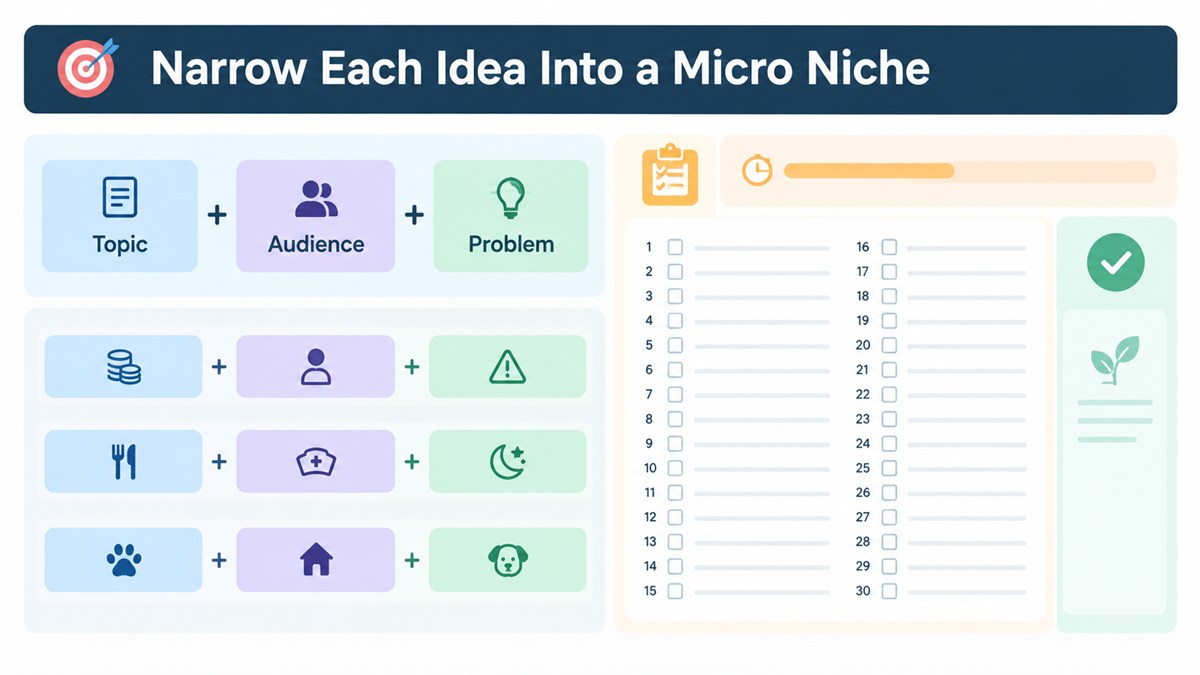
Use this simple formula: Topic + Audience + Problem.
- Budgeting + freelancers + irregular income
- Meal prep + nurses + night shifts
- Pet care + apartment renters + small dogs
Then run a quick depth test. Can you list 30 post ideas in 10 minutes? If yes, the niche has enough depth. If you run dry at eight, it is too narrow.
Step 3: Check Search Demand
Now see if people actually search for your topic. You do not need paid tools to start.
- [Google Trends](https://trends.google.com). Is interest steady or rising? Avoid topics that spike once and vanish.
- Google autocomplete. Type your topic and read the suggestions.
- People Also Ask. These boxes show real questions people type.
- Reddit and Facebook groups. Look for questions that keep coming back.
If you have Ahrefs or Semrush, check ten long-tail keywords in the niche. Look for low keyword difficulty and steady volume. You do not need big numbers. A keyword with 200 searches a month is enough. A hundred of those is a real blog.
Once you have keywords, our guide on how to write a blog post that gets traffic shows how to turn them into posts.
Step 4: Check the Competition
Search your main keywords on Google and look at page one.
Good signs:
- Small blogs and niche sites are ranking
- Forums like Reddit and Quora show up
- Top results are two or three years old
- Articles are thin and lack detail
Warning signs:
- Only big brands rank, such as Forbes, NerdWallet, or Healthline
- Every result is a giant list post with 50 items
- The topic needs medical or legal credentials
A niche with big sites is not always closed. If you can write something more specific and more useful, you can still win. But as a beginner, start where the door is open.
Step 5: Check How You Will Make Money
You can blog about anything for fun. But if you want income, check the options first.
- Affiliate marketing. You recommend products and earn a commission. It works well when readers need to choose between products.
- Display ads. You earn from traffic, so you need steady visitors first.
- Digital products. Templates, guides, and short courses.
- Readers hire you for freelance or consulting work.
- Sponsored posts. Brands pay you once your audience grows.
Quick test: search “[your niche] affiliate program” and “best [your niche] products.” If you find real programs and buying guides, money exists in that niche.
One US rule to remember: if you use affiliate links, you must disclose them clearly to readers.
The 5-Point Blog Niche Scorecard
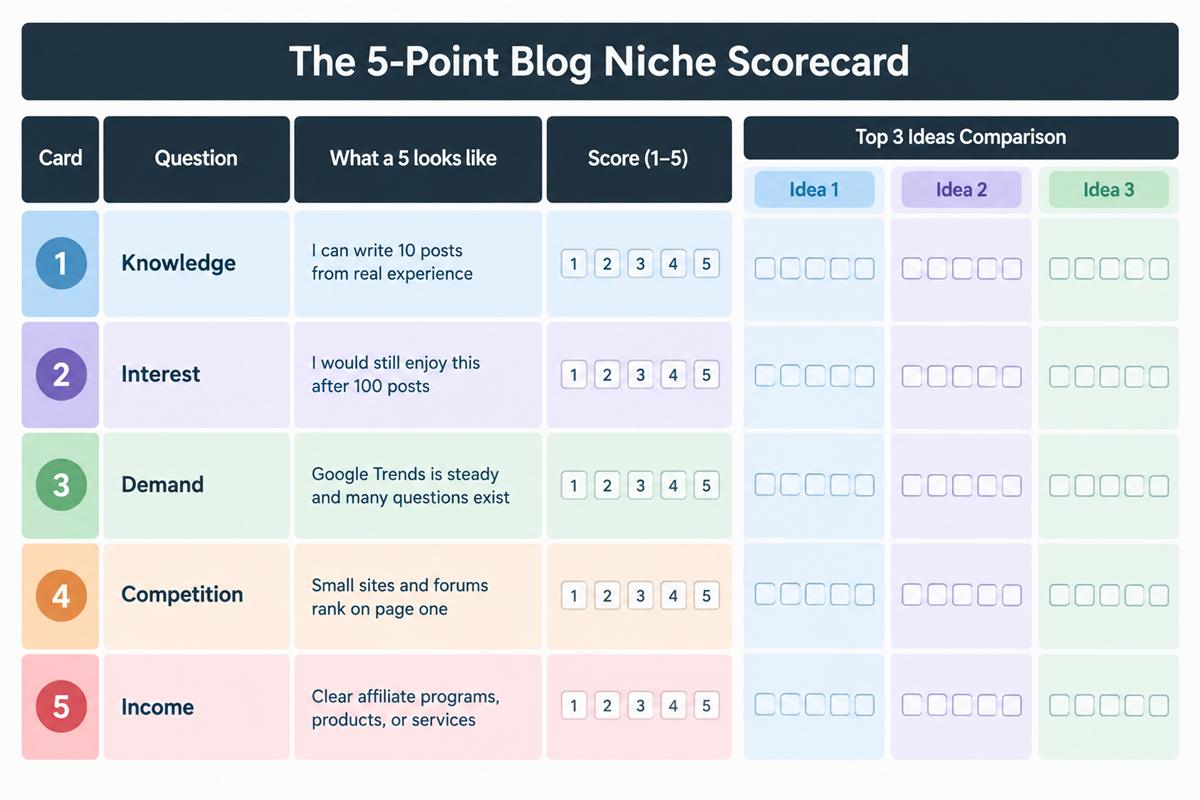
Score each idea from 1 to 5 on the questions below. Be honest. Then compare your top three ideas side by side.
Question | What a 5 looks like |
1. Knowledge | I can write 10 posts from real experience |
2. Interest | I would still enjoy this after 100 posts |
3. Demand | Google Trends is steady and many questions exist |
4. Competition | Small sites and forums rank on page one |
5. Income | Clear affiliate programs, products, or services |
- 20 to 25 points: Strong niche. Start now.
- 15 to 19 points: Narrow it down further.
- Below 15: Pick a different idea.
20 Low-Competition Blog Niche Ideas for US Beginners
These are starting points, not guarantees. Run each one through the scorecard above before you commit.
Money and Career
- Budgeting for freelancers with irregular income
- Side hustles for teachers
- Job search help for career changers over 40
- Student loan payoff for nurses
- Home office setups on a budget
Home and Family
- Small-space organizing for apartment renters
- Meal prep for night-shift workers
- Budget homeschooling resources
- Pet care for apartment dwellers with small dogs
- Caring for aging parents while raising kids
Tech and AI
- AI tools for teachers
- AI tools for real estate agents
- No-code automation for solo business owners
- Phone photography for Etsy sellers
- WordPress speed and security for beginners
Local and Lifestyle
- Weekend getaways from your city under $300
- Moving to your state: cost of living and neighborhood guides
- Free and cheap things to do with kids in your city
- Budget national park trips for first-timers
- Remote-work-friendly small towns in the US
Want to see how AI fits into these ideas? Read our guide on how to start a blog with AI and our overview of how to make money with AI.
Local Blog Niches: A Quiet Way to Beat Big Blogs
Big sites cover “best things to do in the US.” They rarely cover your city, your state, or your neighborhood. That gap is your chance.
Local niches work because searchers add a place name to their query. “Cheap date ideas in Austin” has far fewer competitors than “date ideas.” Local readers also trust writers who clearly know the area.
If you pick a local niche, keep these tips in mind:
- Use place names naturally in titles, headings, and the first paragraph.
- Add real details only a local would know, such as prices, parking, and best times to visit.
- Use your own photos instead of stock images.
- Write in US English and use dollars.
- Set up Google Search Console on day one to see which searches bring readers.
A Google Business Profile is only for real businesses with a location or service area. A hobby blog does not need one. But if you offer local services through your blog, such as coaching or photography, it is worth setting up.
Blog Niches and Mistakes to Avoid
Niches to Skip as a Beginner
- Very broad topics. “Health,” “tech,” and “money” are dominated by huge sites.
- Medical, legal, and money advice without credentials. Google holds these topics to a higher standard. If you write about them, share your own experience and be clear about what you are not.
- A trend that fades in six months leaves you with a dead blog.
- Niches you only pick for money. You will run out of energy before the income arrives.
Common Mistakes
- Chasing the highest ad rates instead of a topic you can sustain
- Changing niche every month
- Skipping the research and picking on gut feeling
- Copying a big competitor instead of finding a smaller angle
- Never testing the idea with real posts
Can You Change Your Blog Niche Later?
Yes. Many bloggers narrow or shift their focus after a few months. It is easier to do early, before you have dozens of posts.
That is why testing matters. Write five posts in your chosen niche. Check Google Search Console after a few weeks. If you see impressions and enjoy the work, keep going. If not, adjust before you invest more.
What to Do After You Choose Your Blog Niche
You have a niche. Now build momentum with these next steps.
- Set up your blog. Follow our step-by-step guide to start a blog with AI.
- Write your first five posts. Use our guide on writing a blog post that gets traffic.
- Pick your tools. Compare the best AI SEO tools for bloggers, the top AI tools for bloggers, and the best AI writing tools.
- Learn the basics of AI writing. Start with how to use ChatGPT for beginners, or browse free AI tools if you are on a budget.
For more guides like this, visit our blogging category.
Blog Niche FAQs
What is the best blog niche for beginners?
The best blog niche for beginners is a micro niche you know well, with steady search demand and a clear way to earn. Examples include budgeting for freelancers, AI tools for teachers, or local travel guides.
How narrow should a blog niche be?
Narrow enough that you can name your reader in one sentence. Broad enough that you can list 30 post ideas. If you can do both, the size is right.
Can I blog about more than one topic?
You can, but it slows growth. Start with one niche until you have 20 to 30 posts. Then add a related topic if it fits your readers.
How do I know if a blog niche is profitable?
Look for affiliate programs, products people buy, and other sites already earning from the topic. Also check that readers search for solutions, not just general information.
Is blogging still worth it in 2026 with AI search?
Yes, if you focus on specific topics and real experience. Broad, generic content is the most exposed to AI summaries. Detailed, first-hand content in a clear niche still earns clicks and trust.
Do I need to be an expert to start a blog?
No. You need to know more than your reader, or be willing to share what you learn honestly. Many successful blogs document the journey, not just the result.
Final Thoughts
Knowing how to choose a blog niche saves you months of wasted effort. Start with what you know. Narrow it into a micro niche. Check demand, competition, and income. Then test with five real posts.
You do not need the perfect niche. You need a good one that you can stick with. Pick your top idea today, score it, and write your first post this week.