
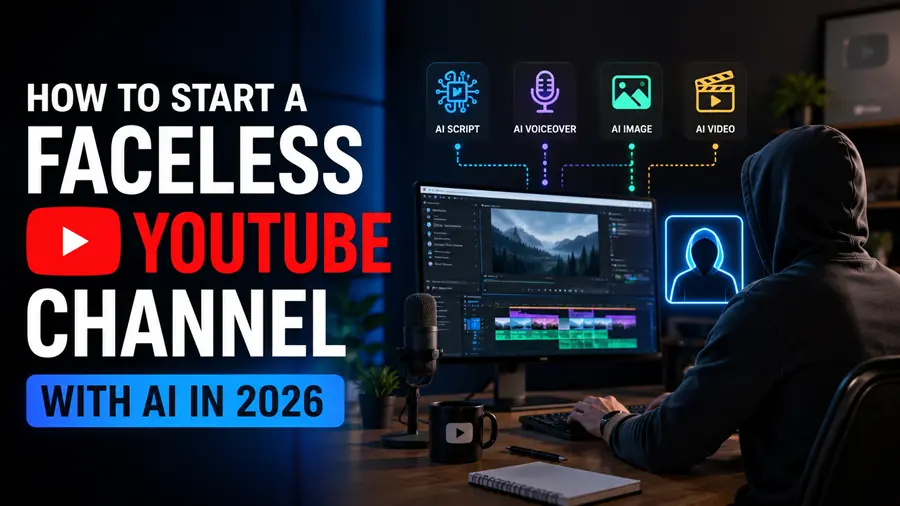
Here is something most “faceless YouTube” articles will not tell you. The AI part is now the easy part. Faceless channels now make up close to 38% of new creator monetization attempts in 2026, up from just 12% in 2022 — and most beginners have not noticed the shift yet. You do not need a camera, an editing degree, or a comfortable on-screen personality. You need a niche, a repeatable AI workflow, and enough patience to keep publishing through the slow first few months.
This guide walks you through exactly how to build one — step by step — using tools that are either free or cheap enough for a genuine beginner budget.
What Is a Faceless YouTube Channel (And Why It Is Growing So Fast)
A faceless YouTube channel publishes videos without making the creator’s face the center of the content. Instead of a talking-head presenter, the channel relies on voiceover, screen recordings, stock footage, animation, or text-led visuals to teach or entertain. Faceless does not mean personality-free — your point of view still comes through in the script, the examples you pick, the pacing, and the voice you use.
What changed in 2026 is production speed. AI now handles scripting, voiceover, visuals, and editing well enough that a solo creator can produce professional-looking videos without hiring an editor, a voice actor, or a production team.
Is a Faceless YouTube Channel with AI Still Worth It in 2026?

Yes — and the monetization rules are identical to any other channel. Faceless channels earn through YouTube ads (AdSense), affiliate marketing, sponsorships, and digital products once they hit the standard monetization thresholds (1,000 subscribers plus 4,000 watch hours, or 10 million Shorts views in 90 days).
Two things are worth knowing before you start. First, the average channel takes around 15.5 months to reach monetization — though niche selection, consistency, and Shorts strategy can cut that dramatically for outlier channels. Second, YouTube renamed its “repetitious content” policy to “inauthentic content” in mid-2025, specifically targeting mass-produced templated videos and readings of material the creator did not actually create. Channels that use AI as a tool inside a genuine creative process — writing your own angle, reviewing every script, adding real research — remain fully compliant and monetizable. Channels that fully automate with zero human input are the ones at risk.
Step 1: Choose a Profitable Faceless YouTube Channel Niche
Your niche decides almost everything else: your RPM (revenue per thousand views), how hard it is to break in, and how sustainable the content pipeline will be. Avoid the two extremes — a niche so broad and oversaturated it is nearly impossible to break into (“motivational quotes” has tens of thousands of existing channels), and a niche so narrow it runs out of content ideas within a few months.
Niche | Typical RPM (US) | Difficulty | Why It Works |
Personal finance & investing | $10–$20 | Medium | Highest advertiser demand on YouTube; viewers are close to a purchase decision |
Legal explainers | $9–$12 | Medium | High-value audience, low content competition relative to demand |
AI & tech tools | $6–$15 | Low | Fastest-growing category in 2026; every AI tool has an affiliate program |
Real estate & business | $8–$12 | Medium | Strong sponsor and affiliate potential alongside ad revenue |
True crime & mystery | $8–$13 | Medium-High | High watch time, but competitive and requires careful sourcing |
History & documentary | $4–$8 | Low | Evergreen demand, long-form friendly, cheap to produce with AI visuals |
Cooking / ASMR / relaxation | $3–$10 | Low | Lower ad RPM but strong non-ad income (affiliates, sponsorships, products) |
Validate a niche before committing: search YouTube for your target keywords, check the first 20 results, and count how many are already faceless. If most top channels are personality-driven, it will be harder to compete. If small, recent channels are still breaking through, the niche is accessible.
Step 2: Build Your AI Production Workflow
Once you have a niche, the actual video-making comes down to four repeatable stages. Here is the workflow most successful faceless creators are running in 2026.
1. Scripting with AI
Use ChatGPT or Claude to turn your video idea into a structured script — hook in the first 15 seconds, a clear value promise, then the body content. If you are new to prompting, our how to use ChatGPT for beginners guide and our 50 best ChatGPT prompts for beginners roundup both include prompt templates you can adapt directly for YouTube scripting.
2. AI Voiceover
Tools like ElevenLabs currently lead on realistic voice quality and offer a usable free tier for beginners. Pick one consistent voice for your channel — viewers subconsciously treat it as your channel’s “personality,” even without a face attached.
3. AI Visuals, B-Roll & Thumbnails
You will need supporting visuals (stock footage, AI-generated imagery) and a strong thumbnail for every upload — thumbnails matter even more for faceless channels since there is no recognizable host to draw the click. Our best AI image generators in 2026 guide covers the free and paid options worth testing first.
4. AI Video Editing & Assembly
Free tools like CapCut and DaVinci Resolve handle cuts, captions, and color grading with no watermark. For a faster end-to-end pipeline, see our best AI video generators in 2026 and our full best AI tools for YouTubers in 2026 breakdown, which covers scripting, thumbnails, editing, and YouTube SEO tools in one place.
Step 3: Optimize Every Video for YouTube SEO

Without a recognizable face, your discoverability depends almost entirely on search and suggested videos doing the work for you. Three things matter most:
- Titles: put your primary keyword within the first 40 characters, and keep it readable — not keyword-stuffed.
- Descriptions: write 150–500 words with natural keyword use, plus timestamps. A study of 1.6 million videos found genuinely useful descriptions outperform keyword-stuffed ones.
- Captions: properly captioned videos appear in roughly 30% more YouTube search results because YouTube indexes the caption text itself.
Tags carry only a weak correlation with rankings — title, description, and actual watch time matter far more. For blog-side keyword research to plan your video topics, our best AI SEO tools for bloggers article covers tools that double up well for YouTube keyword planning too.
Step 4: How Faceless YouTube Channels Actually Make Money
- YouTube ads (AdSense) — the baseline once you hit monetization thresholds.
- Affiliate marketing — nearly every AI tool now offers a 20–40% recurring commission program, which pairs naturally with an AI-tools or tech-review faceless channel.
- Sponsorships — brands increasingly sponsor faceless channels once view counts are consistent, since the content (not the personality) is the draw.
- Digital products — templates, mini-courses, or niche guides sold directly to your audience, which is the highest-margin income stream once you have an engaged viewer base.
If you want the wider picture beyond YouTube specifically, our 15 proven ways to make money with AI and best AI tools to make money online guides cover the full range of AI income streams, including several that stack well alongside a faceless channel.
Best AI Tools for a Faceless YouTube Channel in 2026
Task | Tool | Free Option? |
Scripting | ChatGPT / Claude | Yes |
Voiceover | ElevenLabs | Limited free tier |
Visuals & thumbnails | Canva + AI image generators | Yes |
Video editing | CapCut / DaVinci Resolve | Yes, no watermark |
Full AI video assembly | InVideo AI / Fliki-style tools | Limited free tier |
For a longer list with pricing and beginner notes on each one, see our best free AI tools for beginners guide — every tool listed there is free with no hidden trial trap.
Common Mistakes Beginners Make
- Picking an oversaturated, generic niche (“motivational quotes with stock footage” already has tens of thousands of competitors).
- Quitting before video 50–100. Most successful faceless channels do not break through until this range — YouTube’s algorithm needs that many data points to learn who to show your content to.
- Ignoring Shorts. Channels that post both Shorts and long-form grow roughly twice as fast as long-form-only channels; Shorts are the discovery layer, long-form is the monetization layer.
- Using 100% automated output with zero human review — this is exactly what YouTube’s 2025 inauthentic-content policy targets. Always edit, fact-check, and add a real point of view.
How Long Does It Take to Make Money With a Faceless YouTube Channel?
Industry data puts the average at 15.5 months to reach the standard monetization thresholds. That said, outliers exist in both directions — one finance channel reached 261,000 subscribers in five months with just 20 videos, while others take well over a year. The variable that matters most is not luck; it is niche selection combined with consistent, un-abandoned publishing.
FAQ
Can I really make money on YouTube without showing my face?
Yes. Faceless channels follow the exact same AdSense, sponsorship, and affiliate rules as any other channel, and they already make up a large and fast-growing share of new monetized channels in 2026.
Is AI-generated content against YouTube’s rules?
Not if you are using AI as a tool within a real creative process. YouTube’s mid-2025 policy update targets fully automated, templated content with no human input — not AI-assisted scripting, voiceover, or editing where a person is genuinely involved.
How much does it cost to start a faceless YouTube channel?
You can start for close to $0 using free tiers of ChatGPT, Canva, CapCut, and a limited ElevenLabs plan. Costs scale up only if you move to high-volume, paid-tier AI voice or video generation later.
Which AI voice generator sounds the most realistic?
ElevenLabs is widely considered the current leader for natural-sounding AI voiceover, and it is a common default across most 2026 faceless-channel workflows.
How many videos should I expect to post before seeing results?
Most successful faceless channels do not gain real traction until somewhere between video 50 and 100. Treat the first batch as the algorithm learning your channel, not as a failure.
Final Thoughts
A faceless YouTube channel is one of the most accessible AI-powered income streams available right now — no camera confidence required, and a genuinely low starting cost. Pick one niche, build the four-stage AI workflow above, and commit to publishing through the slow first few months. If you want to explore other AI income streams to run alongside your channel, browse our full Make Money Online category for more free, beginner-tested guides.