

You do not need a journalism degree to make money as a freelance writer in 2026.
You do not need years of experience. You do not need a massive social media following. And you definitely do not need to start by writing for content mills at two cents per word.
What you do need is one thing most beginners skip: a plan for finding real clients who pay real rates.
Freelance writing is one of the most accessible ways to earn online. Every business, blog, SaaS company, and e-commerce brand in the US needs written content. Most of them outsource it. The market for beginner writers is real, and it is bigger than most people realize.
Freelance Writing Jobs for Beginners guide shows you exactly where to find freelance writing jobs as a beginner, what to charge, how to build a portfolio without prior clients, and how AI tools can help you work faster.
Is Freelance Writing Still Worth It in 2026?
Yes. The demand for quality content is not slowing down.
Businesses need blog posts, email newsletters, product descriptions, website copy, LinkedIn articles, case studies, and social media content. Most companies cannot produce all of it internally. They hire freelance writers to fill the gap.
Freelance writer Elna Cain documented that she hit $4,000 in monthly income within seven months of starting, beginning with $25 blog posts on Upwork. That worked in a niche with steady demand and low competition at entry level.
That story is not unusual. What is unusual is the patience and consistency it took to get there.
Here is what beginner freelance writing income realistically looks like:
| Stage | Timeline | Monthly Income |
|---|---|---|
| First samples + profile setup | Week 1 to 2 | $0 |
| First paid article | Week 3 to 5 | $25 to $100 |
| Building early clients | Month 2 to 3 | $200 to $600 |
| Consistent work | Month 4 to 6 | $600 to $2,000 |
| Established writer | Month 7 to 12 | $2,000 to $6,000+ |
Getting to $2,000 per month in your first year is completely realistic for writers who pick a niche, build a portfolio, and pitch actively. Most people who fail quit in month two, right before their pitching effort starts to compound.
Step 1: Pick a Writing Niche
This is the most important decision you will make as a beginner freelance writer. Generic writers compete against thousands of people. Niche writers compete against far fewer — and charge more.
Beginners land first jobs through marketplaces like Upwork by taking small projects, over-delivering, and collecting reviews. But the writers who build serious income fast all specialize.
Your niche does not have to be something you studied formally. It just needs to be an area where you have some knowledge or genuine interest.
Niches with strong demand in the US right now:
Personal finance and investing — one of the highest-paying writing niches. Businesses pay $150 to $500 per article for well-researched finance content.
SaaS and technology — software companies need constant blog content. Technical writers in this niche routinely earn $0.20 to $0.50 per word.
Health and wellness — enormous market, consistent demand. Works best when you have personal experience or professional background in the topic.
Real estate — agents, brokers, and property companies all need content. Relatively low competition among freelance writers who specialize here.
AI and online earning — this is your site’s own niche. Writers who understand AI tools and can write about them clearly are in demand right now.
E-commerce product descriptions — high volume, repeatable work. Shopify brands pay $15 to $50 per product description and need hundreds of them.
Tip: Do not try to write about everything. The writers earning the most specialize in one area, become known for it, and charge accordingly. “Freelance writer for US SaaS companies” earns far more than “freelance writer for anyone.”
Step 2: Build a Writing Portfolio Before You Have Clients

This is where most beginners get stuck. They believe they cannot apply for work without a portfolio, and they cannot build a portfolio without work. That logic is wrong.
You can build a portfolio right now with self-created samples.
Write 3 articles for fictional brands in your niche. Choose the exact type of content you want to be hired for. Blog posts, email newsletters, product descriptions, or case studies. Create them as if a real client paid for them.
Start a simple Medium or Substack publication. Publish 3 to 5 articles there. These become your live portfolio links. Editors and clients can click and read your actual work, not just a PDF.
Guest post for free. Reach out to blogs in your niche and offer a free guest post. The byline and the published article become portfolio pieces. One published article on a real website is worth more than ten samples on your Google Drive.
Use Google Docs for presentation. Format each sample professionally. A clear headline, well-structured body, a short bio at the top. Save them as shareable links so you can paste them directly into pitches.
The key is creating your own samples before you apply for jobs. Those self-created samples are enough to get your first paid gig.
Your portfolio does not need to have paid work in it. It needs to prove you can write. Those are different things, and clients care about the second one.
Step 3: Find Your First Freelance Writing Jobs
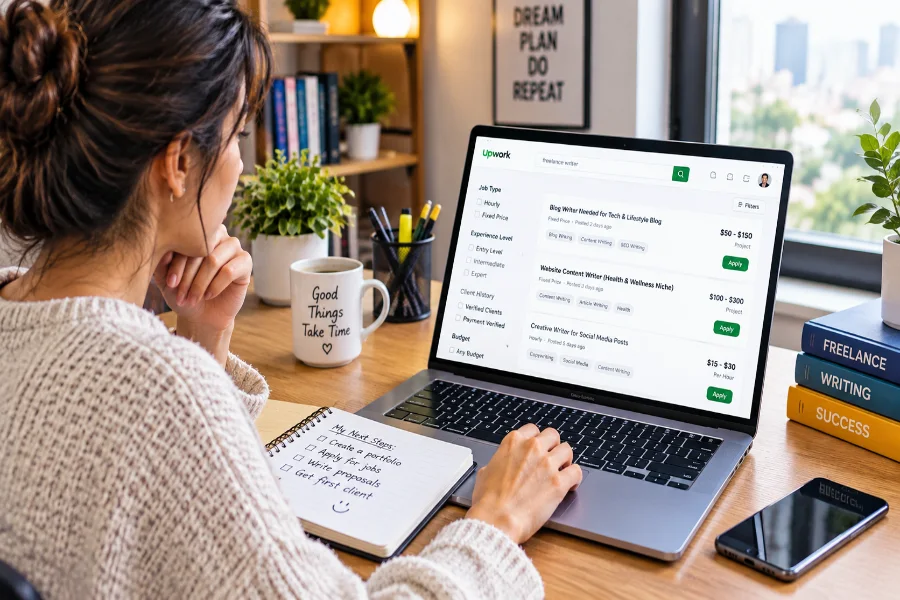
Here are the places that work for complete beginners in 2026, ranked from fastest results to slowest.
Upwork
Platforms like Upwork are the obvious starting points. They have a massive volume of listings, including entry level freelance writing jobs that do not require prior experience. The trade-off is competition and low initial rates. Think of it as paying your dues.
Apply to writing jobs posted within the last 24 hours. Use the Payment Verified filter. Write proposals that open with the client’s specific content need, not your background. Your first three to five projects will be lower-paying. That is intentional — you are building reviews that unlock higher rates.
Read our full guide on how to make money on Upwork for the exact proposal structure and filter strategy that gets responses.
Fiverr
Create a gig specifically for your niche. Not “I will write content” but “I will write SEO blog posts for health and wellness brands.” Specific gig titles rank better in Fiverr search and attract clients who are ready to pay.
Our Fiverr beginner guide covers exactly how to set up your gig, price your packages, and get your first order without waiting weeks.
LinkedIn is probably the single best platform for finding freelance writing work if you use it actively. Post occasionally about content strategy, writing tips, or insights from your work.
Update your LinkedIn headline to say what you write and who you write for. Post once per day about writing, content strategy, or a tip related to your niche. Send 10 connection requests per day to content managers, marketing directors, and founders at companies that publish the type of content you write.
ProBlogger Job Board
This is a curated board specifically for writing and blogging jobs. The listings are from companies who are actively hiring, and many of them welcome beginner applications. Check it every morning and apply to any listing that matches your niche.
LinkedIn is the single best platform for finding writing work, and ProBlogger is the default job board for freelance writers.
Cold pitching
Cold pitching is a fabulous way to land recurring writing gigs. There is much less competition and you will have a better chance at landing work when you contact clients directly, especially if you are brand new to freelance writing.
Find 20 companies in your niche that publish a blog but have not posted recently. Send them a short email: introduce yourself, mention one specific idea you have for their blog, and link to your best sample. Keep the email under 150 words. This method takes longer but produces higher-paying clients than any marketplace.
Step 4: What to Charge as a Beginner Writer

Pricing is where most beginners hurt themselves in two opposite directions. They either charge so little that clients assume low quality, or they price themselves out of the beginner market before they have any reviews.
Here are realistic beginner rates by content type in the US market:
| Content Type | Beginner Rate | After 10 Reviews |
|---|---|---|
| Blog post, 1,000 words | $40 to $75 | $100 to $250 |
| Blog post, 1,500 words | $60 to $100 | $150 to $350 |
| Email newsletter | $35 to $65 | $100 to $200 |
| Product description | $15 to $30 | $40 to $80 |
| LinkedIn article | $50 to $100 | $150 to $300 |
| Website homepage copy | $100 to $200 | $300 to $800 |
If you want to understand how these rates compare to other freelance services and which skills command the highest pay, read our breakdown of the best freelancing skills to learn in 2026.
Do not charge per word at the beginner stage. Clients who pay per word tend to want volume over quality and push rates down. Charge per piece or per project. It gives you more control over your time and positions you as a professional, not a production machine.
After your first 10 positive reviews, raise your rates by 20 to 30 percent. After 25 reviews, raise them again. Do not stay at beginner rates past your first three months.
Step 5: Use AI Tools to Write Faster Without Lowering Quality

This is what separates 2026 freelance writers from those working the same way they did in 2022. AI tools do not replace your writing skill. They remove the friction around it.
ChatGPT for outlines and research
Use ChatGPT to build an outline for any article in minutes. Paste the article topic and ask for a detailed H2/H3 structure. Research the main points for each section. Then write each section yourself.
You go from staring at a blank page for 30 minutes to having a complete road map in 5 minutes. That is time you spend writing and billing, not overthinking structure.
For more on using ChatGPT effectively, our complete ChatGPT beginner guide covers exactly how to write better prompts and get usable output.
Grammarly for proofreading
Every article you send to a client is an audition for your next project with them. Typos and grammar errors in a delivered article are a fast way to lose a repeat client. Install Grammarly’s free browser extension. It runs in the background while you write in Google Docs, WordPress, or wherever you work.
Hemingway App for readability
Hemingway App highlights sentences that are too long, passive voice, and words that can be simplified. Clients in 2026 want content that is easy to read. Most editors look for Grade 6 to 8 readability. Hemingway helps you hit that target without guessing.
Notion AI for organization
When you have multiple writing clients with different deadlines, styles, and content briefs, staying organized is not optional. Notion AI helps you manage content calendars, client notes, deadlines, and payment tracking in one place.
Important: Use AI to speed up your process, not to replace it. Clients hire you for your judgment, your voice, and your ability to understand what they need. AI output that goes to a client unedited is a risk to your reputation. Always review, rewrite, and personalize before you submit.
Common Beginner Mistakes That Slow Down Progress
Writing about everything for everyone
A profile that says “I write blog posts, social media, emails, product descriptions, and more” tells clients nothing. They want a specialist, not a generalist. Narrow your focus to one content type for one niche.
Waiting for applications to work
Job boards and Upwork are reactive. You wait for jobs to appear, then compete with 20 to 50 other applicants. Cold pitching is proactive. You find the exact company you want to write for and make them an offer before they even post a job. Mix both approaches for the fastest results.
Underpricing and staying there
Low-quality gigs are easy to find. The best freelance writing gigs require a little imagination, networking, and long-term work to score.
Starting at $25 per article is fine for your first three clients. Staying at $25 per article six months later is not. Raise your rates after every 10 positive reviews. Clients who value quality will follow you up. Clients who only care about price will leave, and that is fine.
Ignoring the follow-up
Most pitches and proposals need a follow-up. Editors and content managers are busy. Send one follow-up message 4 to 5 days after your initial pitch. Keep it short: “Just wanted to follow up on my pitch from last week. Happy to adjust the angle if you have a different direction in mind.” A surprising number of writing jobs come from the follow-up, not the first message.
Freelance Writing and AI: What Clients Actually Think
There is a lot of noise about AI replacing freelance writers. Here is the realistic picture.
Businesses need content that is accurate, original, and sounds like a real person wrote it. AI tools can produce drafts quickly, but clients who have tried using AI directly know the output needs significant human editing to be usable.
What clients want in 2026 is a writer who uses AI intelligently and still produces original, accurate, well-researched content. That combination — human judgment with AI efficiency — is what the best-paid freelance writers offer.
If you want to understand how AI fits into a broader online earning strategy, our guide on how to make money with AI in 2026 covers 15 different methods including writing, blogging, and content creation.
Frequently Asked Questions
How do I start freelance writing with no experience?
Start by choosing one niche and creating 3 self-made writing samples in that niche. Publish them on Medium, Substack, or as shareable Google Docs. Set up a profile on Upwork or Fiverr with a specific niche headline. Apply to jobs or offer a guest post to blogs in your niche. Your first client does not care about your resume. They care about whether you can write what they need. Three strong samples in your target niche are enough to get started.
How much can a beginner freelance writer earn in 2026?
Most beginners who pitch consistently earn $200 to $600 per month by month 2 or 3. By month 4 to 6, writers with 10 or more positive reviews and a specific niche typically earn $600 to $2,000 per month. Reaching $3,000 or more per month usually takes 8 to 12 months of consistent client work and rate increases. Results depend entirely on niche selection, pitching consistency, and how quickly you raise your rates.
Do I need a degree to become a freelance writer?
No. Freelance writing has no formal qualification requirements. Clients in the US care about your ability to write clearly, deliver on time, and understand their content needs. A strong portfolio of writing samples matters far more than any credential. Many of the highest-earning freelance writers have no formal writing training.
What is the best platform for beginner freelance writers?
Upwork is the best starting platform for beginners willing to pitch daily. Fiverr is better for beginners who prefer clients to find them through search. LinkedIn is the best long-term platform for building professional writing clients. Most successful writers use all three — Upwork and Fiverr for early reviews, LinkedIn for higher-paying long-term clients.
How long does it take to get the first freelance writing job?
Most beginners who apply consistently — at least 5 pitches or proposals per day — land their first paid writing job within 2 to 4 weeks. Beginners who send fewer applications or use generic proposals can wait months without a response. The quality and specificity of your pitch matters more than the volume.
Can I use AI tools as a freelance writer?
Yes. Using AI tools to research, outline, and draft content is acceptable and widely practiced in 2026. The key is that AI produces a starting point — not the final deliverable. Always edit, fact-check, and personalize AI-assisted content before submitting to a client. Clients who discover they received unedited AI output rarely come back.
What writing niche pays the most in 2026?
Technical writing for SaaS companies and personal finance content consistently pay the highest rates for freelance writers in the US. Technical writers with AI or software knowledge earn $0.20 to $0.50 per word or $150 to $500 per article. Personal finance writers with a financial background can earn similar rates. Both niches have strong demand and pay well above the beginner average.
How do I build a writing portfolio with no clients?
Write 3 articles for fictional brands in your niche and save them as shareable Google Docs. Start a free Medium or Substack publication and publish your samples there so they have a live URL. Offer one free guest post to a real blog in your niche in exchange for a byline. These three steps give you a professional portfolio before you have a single paying client.
Final Thoughts
Freelance writing in 2026 is one of the most accessible income streams available to US beginners. The tools are better, the demand is real, and the platforms that connect writers with clients are more developed than they have ever been.
But the fundamentals have not changed. Pick one niche. Build three strong samples. Pitch every day. Follow up. Raise your rates.
That process is boring. It is repetitive. And it works consistently for writers who stick with it past the first 60 days, when most beginners give up.
Your first paid article is closer than it feels. Start writing your samples today.